The intelligence behind Fornasarig stackable furniture
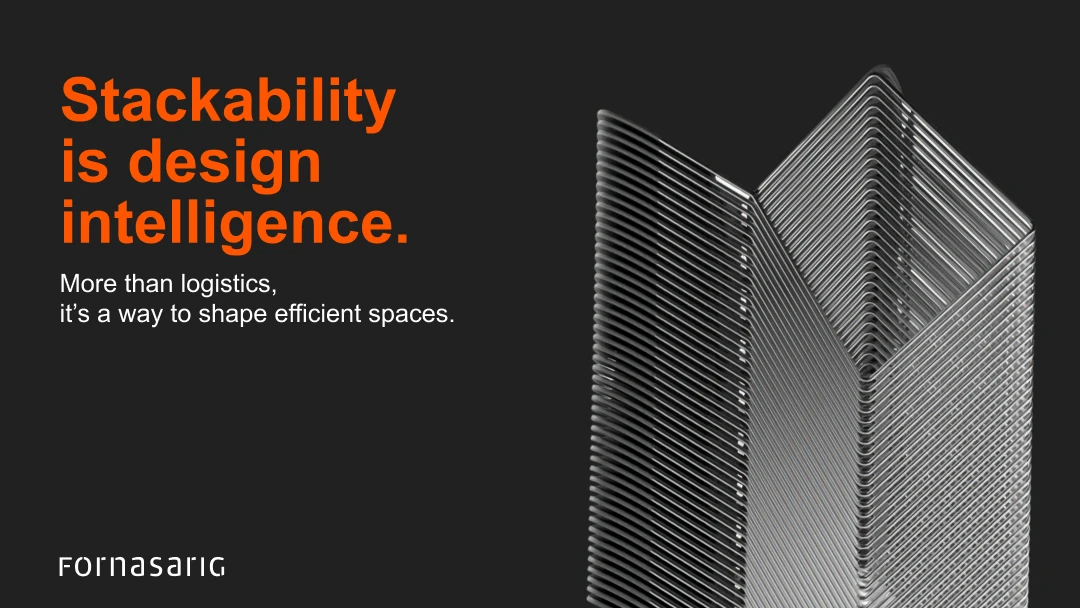
Stackable furniture is the expression of design intelligence not just a practical solution.
In the world of contract interiors, where every second and square meter matters, flexibility defines success, as many Fornasarig customers know. Every piece of furniture must adapt as quickly as the people who use it. For this reason, stackable furniture reflects a new mindset: it allows spaces to evolve, to transform, and to breathe.
Behind this apparent simplicity lies a deep design philosophy. Every curve, joint, and angle is the result of precision engineering and material research. Through this process, designers turn geometry into movement and balance into logic. It’s not only about fitting one chair over another, but about creating an invisible rhythm that connects design, ergonomics, and function.
As a result, for architects and project planners this rhythm translates into freedom, the freedom to design spaces that change configuration without losing harmony. Whether in a conference hall, a university, or a hospitality environment, stackable furniture enables a new kind of intelligence: space that learns, moves, and adapts.
Fornasarig has embraced this concept for decades, and over time has turned the idea of stackability into a distinctive design language. In its collections, movement and modularity are not afterthoughts but founding principles, a vision where elegance and utility coexist naturally.
From functionality to philosophy
The story of Fornasarig’s stackable furniture begins with a challenge: to achieve lightness without losing strength.
For decades, wood was the company’s signature material, elegant, tactile, and timeless. Yet, as contract spaces evolved and demanded ever greater mobility, a new approach became necessary. Designers at Fornasarig began experimenting with how to merge contrasting materials, wood, steel rod, and high-performance polymers, to create structures that were both strong and flexible.
This exploration gave birth to the Link 60X, a chair that redefined what stackability could mean. Its 11-millimeter solid steel rod frame provides structural integrity, while the seat and back, moulded from reinforced polyolefin resin, add ergonomic comfort and elasticity. The result is a chair that stacks sixty units in less than two meters, combining extreme compactness with visual lightness. It is not simply functional; it is an embodiment of design intelligence.
From this foundation, the philosophy extended to other collections. The Wolfgang 50X takes the same logic. Its poly shell and sled base make it easy to stack up to fifty chairs on a single trolley, allowing conference rooms or dining halls to transform in minutes. Beneath its apparent simplicity lies advanced engineering: precise welding, powder-coated finishes, and optimized geometry for balance and stability.
In educational settings, adaptability becomes even more crucial. The Link Edu Desk brings stackability into a different typology, a writing desk that can be stacked up to thirty pieces on a trolley, maintaining the same comfort, strength, and visual coherence as the Link family. In this way, Fornasarig translates the same DNA of movement into every detail: ergonomic angles, durable surfaces, and sustainable materials that can be easily separated and recycled.
Through these designs, Fornasarig proves that functionality can evolve into philosophy and when efficiency meets elegance, stackability becomes a form of intelligence. This is the reason why each model, from the iconic Link 60X to the versatile Wolfgang 50X and the educational Link Edu Desk, demonstrates how engineering and aesthetics merge to serve people and the spaces they inhabit.
Sustainability through motion
Fornasarig’s stackable furniture embodies sustainability not only through its materials, but also through movement. Every time a chair stacks perfectly and resources are optimized. Fewer trucks, less storage, lower emissions. Each centimeter saved becomes an environmental act in which Fornasarig believes.
It should also be noted that efficiency is crucial in the logistics of large-scale projects. Stackable furniture reduces packaging volume, transportation requirements, and handling time. As a result, fewer materials are consumed, and each stage, from production to delivery, has less impact on the planet.
Fornasarig applies this principle through intelligent engineering and responsible material choices. The steel rod frames are welded with Mig and Tig processes that minimize waste and guarantee long-term durability, while the reinforced polyolefin resin used for Link 60X is 100% recyclable and designed for easy disassembly.
Moreover, each product in the stackable furniture family follows a circular logic: components remain distinct, allowing materials to be recycled separately at the end of the life cycle. In this way, stackability extends beyond spatial efficiency, it becomes a system of sustainability.
At the same time, reducing volume also means optimizing storage in architectural terms. Spaces once dedicated to storing unused furniture can now serve new purposes: creative areas, relaxation corners, or collaborative zones. What begins as a technical decision ends as a design opportunity.
Ultimately, sustainability in motion is not an abstract concept for Fornasarig; it is a measurable outcome. Through innovation, durable materials, and compact logistics, the company transforms flexibility into environmental responsibility. Stackable furniture shows that intelligent design can move beautifully, and responsibly, at the same time.
Fornasarig’s vision: adaptability as design culture
Adaptability is not a trend for Fornasarig, it is a design culture rooted in over a century of craftsmanship and research.
Since 1878, the company has explored how seating can enhance not only comfort, but also the dynamics of human interaction. Every evolution in materials, from solid wood to steel rod to reinforced polymers, has been driven by one idea: designing furniture that evolves along with people’s needs.
In today’s contract environments, adaptability defines longevity. A chair that stacks efficiently, resists wear, and remains timeless in form can accompany countless configurations, projects, and stories. In this sense, Fornasarig’s stackable furniture is a bridge between design and duration, a visible symbol of intelligence that endures.
Moreover, the flexibility achieved through Fornasarig’s engineering is never purely mechanical. It is emotional because spaces that can be transformed easily create freedom. They allow architects, educators, and hospitality designers to imagine fluid environments that adapt to human needs, not the other way around.
At the same time, this philosophy is linked to sustainability and elegance. True adaptability reduces waste, extends the life of products, and pays homage to the timeless aesthetics of Italian design.
…and when an object remains relevant for decades, like a Fornasarig product, it becomes part of an architectural dialogue that transcends its function.
Ultimately, Fornasarig’s vision is simple yet profound: to design objects that gracefully stand the test of time. For this reason, modern stackable solutions become more than just furniture: they become a language of intelligence, beauty, and care for the world we build together.